Dietary Supplement Claims Text Substantiation

Make claims you can prove.

Dramatically shorten the time from research to ingredient substantiation documentation with ClaimsText.

app.claimstext.com
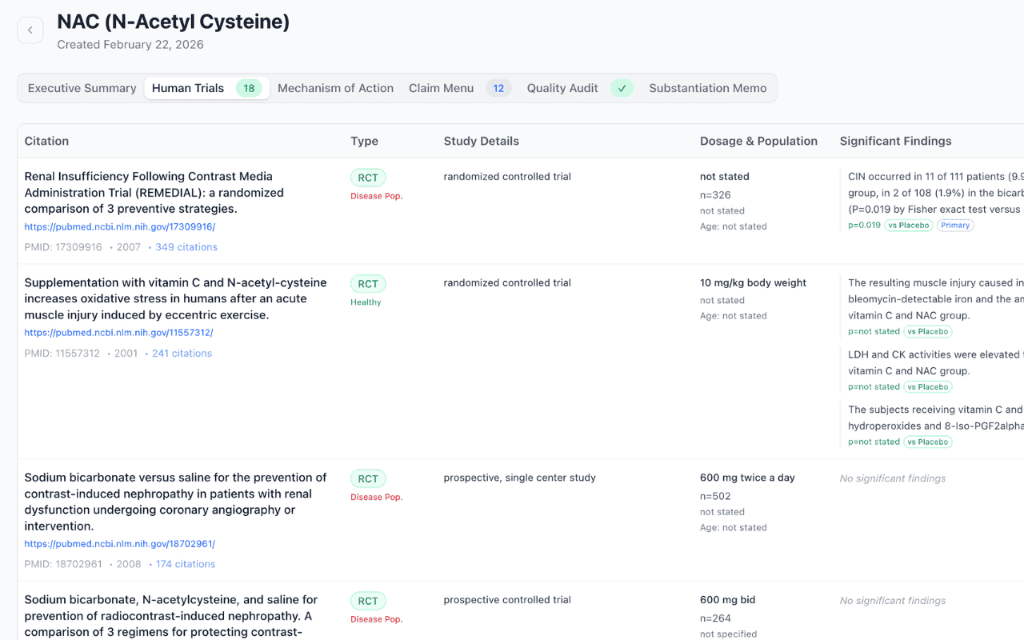
ClaimsText clinical evidence report showing NAC trials with study details and substantiation data
Search countsFindings againstDose fitTen-criterion screenSigned and locked

ClaimsText reads through 100s of ingredient studies in minutes.

Then comes up with potential claims you can substantiate.

What goes into the file

ClaimsText does the search, extraction and screening that would normally take many hours of expensive compliance consultancy. Here’s how that works.

Step 01

Search

A multi-tiered search on PubMed. We show you exactly how every search is performed.

Step 02

Extract

Design, population, dose and outcome for each trial. Zero human bias that wouldn’t survive FTC scrutiny.

Step 03

Screen

Your product’s dose compared against studied dose. Each potential claim tested against all ten disease claim criteria.

Step 04

Sign

Tracked sign off of your chosen claims text. Locked memos, and exportable PDFs and a full document pack.

End-to-End Dietary Supplement Claims Text Substantiation

Built for brands and their regulatory consultants to accelerate the claims text substantiation process.

Search provenance

Full ingredient search across PubMed & our internal database, reporting how many matched, how many were retrieved.

Contrary findings kept

Trials where the ingredient did NOT beat placebo sit beside the ones where it did. Proper substantiation includes all positive and negative evidence.

Per-criterion disease-claim screen

Every claim tested against all ten criteria of 21 CFR 101.93(g)(2), with the verdict and the triggering wording shown for each.

Dose fit

The studied dose against the dose on the label, per claim. Evidence from a dose the product does not reach is marked, not hidden.

A confidence score you can argue with

Eight named components, each with its reasoning written out, so a reviewer can disagree with a line rather than a number.

Sign off process

Each report carries a brand name, responsible person and compliance officer, then locks once signed. Perfect for brand owners and compliance consultants.

Plans for Brands & Consultants

Every plan offers the same outputs. For small brands with one or two SKUs, large brands with significant compliance needs, or for compliance consultants who manage multiple brands.

Brand

25 reports a month

$999/month
  • 25 ingredient searches a month
  • Unlimited LabelScans*
  • Unlimited Copy Checks*
  • Unlimited ClaimsText Edits
Choose Brand

Consultancy

Unlimited reports, for a client roster

$5,000/month
  • Unlimited ingredient searches
  • Unlimited LabelScans*
  • Unlimited Copy Checks*
  • Unlimited ClaimsText Edits
  • Dedicated support
Choose Consultancy

* Fair use policy applies

Already have an account? Sign in

Frequently Asked Questions

Straight answers on what the report does and does not do.

No. It does the search, the extraction and the disease-claim screen, and writes down what it did and how far it got. Deciding which claims to make, and signing the memo, stays with the person responsible. Many of the people it is built for are consultants running it for their clients.

Whoever reviews and signs it. Each report carries its own brand name, responsible person and compliance officer, set before signing, and the memo prints all three. A consultant can run reports for several client brands from one account, with their own name as the compliance officer on each.

ClaimsText searches PubMed for clinical trials on your ingredient, records how many matched and how many it retrieved, and extracts what each study measured: design, population, dose, p-values and effect sizes. It keeps the findings that went against the ingredient as well as the ones in its favour, distinguishes across-group from within-group significance, checks the studied dose against the dose your product delivers, and scores confidence on eight named components with the reasoning written out.

Every claim is drafted as a structure–function claim and then screened against the ten disease-claim criteria in 21 CFR 101.93(g)(2), with a verdict on each criterion. The report shows each verdict and the wording that triggered it, so a reviewer can see why a claim passed rather than take it on trust. ClaimsText assists professional review; it does not replace it. The responsible person named in the memo makes the final call and signs it.

The counts. Each search records how many records matched and how many were retrieved, and a capped search is reported as capped. Where something could not be assessed, the memo says “not assessed” rather than staying silent, because silence in a signed document reads as assurance.

PubMed/MEDLINE, and our internal database of PubMed studies already analysed for earlier reports, re-extracted whenever that analysis is out of date. Peer-reviewed human trials: randomised controlled trials, meta-analyses and systematic reviews. The report lists the search terms and the counts it used.

It is used to produce the report and for nothing else on our side. We do not sell it, and our AI providers are chosen on data-processing terms that exclude training on it. The privacy policy names the processors involved and how long data is kept.

Five to fifteen minutes to produce, depending on how much literature there is. Reviewing it takes as long as a review should; the point is that the search, extraction and screen are written down, not that they were quick.

Yes. Both documents, the clinical evidence report and the substantiation memo, export as PDF, formatted for a regulatory file or a client deliverable.

Each report is one ingredient: the complete evidence report, the screened claims and the substantiation memo for that ingredient. Your monthly allowance resets on your billing date.

Yes. The sample report is a complete ashwagandha report, run by ClaimsText’s founder for his own supplement brand, BioStack Labs, with nothing edited out. For your own product, LabelScan at labelscan.claimstext.com checks the label against 21 CFR 101 free and emails the findings; choose a plan when you want full reports on your ingredients.

Substantiation is the evidence behind a health claim on a supplement label or in its marketing. The FDA requires structure–function claims to be truthful, non-misleading and substantiated by competent and reliable scientific evidence, and the FTC applies the same standard to advertising. In practice that means human clinical trials, read in full, including the ones that went the other way.